OPEN TO RESEARCH COLLABORATIONS

Accessible Computing AI for Accessibility Software Engineering

I build ways into visual worlds.

I’m Rubel. I work at the intersection of accessibility, HCI, and generative AI. I design and study accessible programming technologies for blind and low-vision learners in K-12 computer science education.

Explore my work

Alt + J next chapter · Alt + A ask the guide · or simply scroll

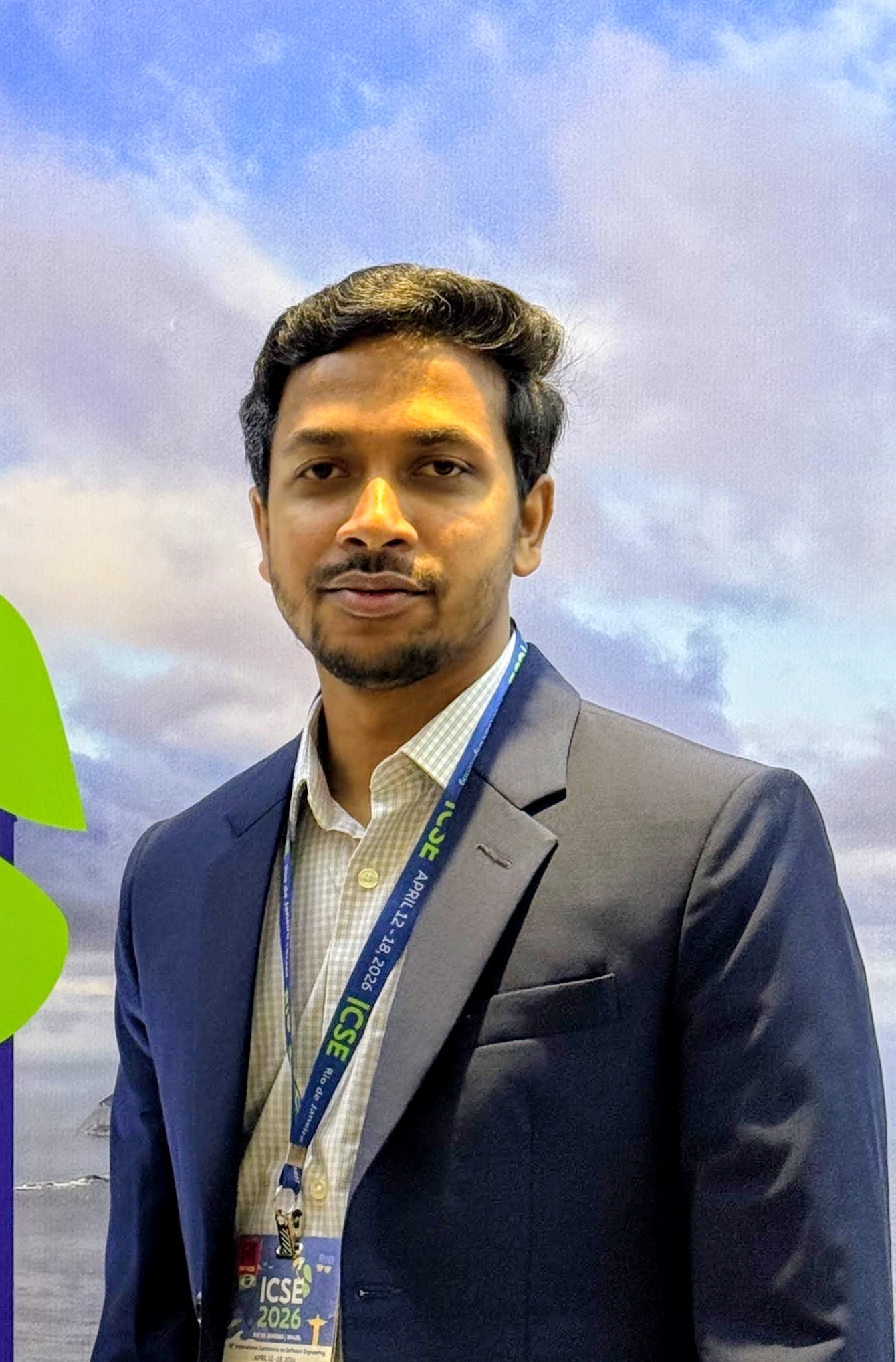
Rubel Hassan Mollik at ICSE 2026 in Rio de Janeiro.
Denton, Texas · CST

Chapter 01 Current research work

Code should open doors, not draw new boundaries.

Block-based programming environments support introductory computer science education, but their visual and drag-and-drop interactions create persistent accessibility barriers.

My current research investigates how these environments can support complete nonvisual programming workflows. I design modular approaches for structured keyboard navigation, code editing, screen-reader feedback, and accessible program output. I also co-design with teachers of students with visual impairments to connect technical decisions with classroom practice.

Read about my research
Identify barriersCo-designBuild and integrateEvaluate

Chapter 02 Recent research questions

Questions guiding my recent work.

These questions connect accessible interaction, classroom practice, and evidence-based uses of AI.

  1. Question 01 Accessible systems

    How can block-based programming support complete nonvisual coding workflows?

    I study modular architectures, structured navigation, mode-based editing, and compatibility with external screen readers across Blockly-based platforms.

    Explore the prototype
  2. Question 02 Co-design

    How should accessible programming tools be designed for K-12 classrooms?

    I work with teachers of students with visual impairments to study code comprehension, accessible output, classroom integration, and support for blind and low-vision teachers.

    Read the publications
  3. Question 03 Evidence synthesis

    How can generative AI support accessibility responsibly?

    I examine how AI supports accessibility tasks, which disability groups and standards are represented, and where evaluations need greater involvement from people with disabilities.

    Review the evidence

Chapter 03 Featured publications

Featured publications.

View all publications
  1. ASSETS ’26 K-12 · Co-design

    Accessible Block-Based Programming for K-12 Classrooms

    RH Mollik, VK Kosuri, H Djalali, K Patel, N Lester, A Mountapmbeme, S Ludi

    A co-design study with 11 teachers of students with visual impairments, including four teachers who are blind or visually impaired.

  2. UAIS ’26 Literature review

    Understanding Design and Accessibility Issues in Block-Based Programming

    RH Mollik, W Aljedaani, S Ludi

    A systematic review of 22 studies that identifies accessibility barriers, proposed solutions, and directions for future research.

  3. UISE ’26 Framework · Blockly

    An Extension-Based Accessibility Framework for Blockly

    RH Mollik, VK Kosuri, H Djalali, S Ludi, A Mountapmbeme

    A modular framework for structured keyboard navigation, accessible editing, and compatibility with external screen readers.

  4. ASSETS ’26 Accessibility education · Figma

    Designing and Evaluating an AI-Powered Figma Plugin for Accessibility Education

    W Aljedaani, PD Parthasarathy, RH Mollik, AK Badamalolu

    An evaluation of an AI-powered Figma plugin that provides contextual WCAG feedback during design, based on a three-week deployment with 89 participants.

  5. Web4All ’26 Systematic review · LLMs

    Large Language Models for Web Accessibility: A Systematic Literature Review

    W Aljedaani, RH Mollik

    A systematic review of 38 peer-reviewed studies examining accessibility tasks, standards, LLM approaches, and evaluation methods in web accessibility research.

Chapter 04 Research interests

Research informed by software engineering practice.

Before beginning my Ph.D., I spent six years building backend systems in Dhaka, including machine-learning tools for legal analytics at Consilio and payment gateway services at bKash.

That experience shapes how I approach research. I value systems that integrate with existing platforms, support real users, and can be evaluated in realistic settings.

View my experience

Research interests

  • Accessibility
  • Computer Science Education
  • AI for Accessibility
  • Human-Computer Interaction

Final chapter Start a conversation

Start a conversation.

I welcome conversations with researchers, educators, students, and accessibility practitioners. A conversation today may become the beginning of our next chapter together.

Email Rubel